

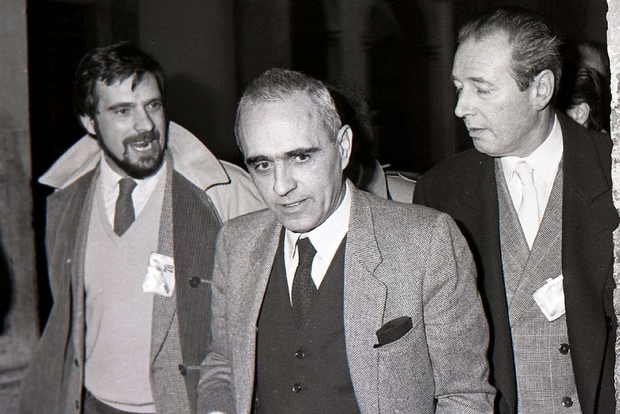
Below is an interview with the General Secretary of the CISL, Annamaria Furlan, in memory of Pierre Carniti.
Source: https://www.avvenire.it/attualita/pagine/morto-pierre-carniti-sindacalista-leader-cisl
Pierre Carniti, a longtime CISL trade unionist and former senator, died today at the age of 81. Born in Castellone, in the province of Cremona, on September 25, 1936, the grandson of the poet Alda Merini, in 1970 he became secretary of the FIM, the CISL metalworkers' organization, and subsequently served as its secretary from 1979 to 1985. A member of the European Parliament for two terms, from 1989 to 1999, Carniti also served as a senator, elected with the PSI, in 1993 and 1994. The Senate remembered him with a minute's silence in the chamber of Palazzo Madama. Here's Annamaria Furlan's remembrance, general secretary of the CISL.
I met Pierre Carniti many years ago, when I was very young and full of ideals, I began my trade union journey in the CISL. Pierre was a extraordinary figure, a constant point of reference for all of us, a man who marked the history of the trade union movement with his battles, his intuitions, his political, moral and spiritual coherence.
Carniti, along with Marini, Crea, and Colombo, are part of that "second generation" of CISL unionists who trained in the 1960s at the Florence study center, where they learned the lessons of Giulio Pastore and Mario Romani. Carniti himself recalls this well in a beautiful passage from his latest book: "Those teachings and principles for a new, democratic, modern union offered even the most remote CISL unionist such a solid toolbox that he had no inferiority complex toward the theoretically-sounding smokescreens of communist intellectuals." This sentence captures Carniti's forthright nature and the path of the unionist decisions, at times even radical ones, made throughout his union career.
The union is centered on workers, distinct from employers' organizations, the political party, the church, associations, and so on. The union's only limit to its autonomy is its responsibility to sign contracts and make agreements. No ifs, ands, or buts. Not doing so would negate its own function. This is essential to understanding the greatness of the trade unionist and all the choices Pierre Carniti made throughout his life: the union's autonomous political subjectivity is crucial to judging the CISL's trade union action, which was the foundation of the union. of the 1984 Valentine's Day agreement on the cutting of the sliding scale and which laid the foundations for the subsequent season of agreements on income policy in the early nineties.
Union power forces you to take on greater governance responsibilities if you truly want to protect those you represent, unless your goals are more far-reaching. This was the dividing line between the CISL and CGIL in 1984, when Berlinguer's PCI warned the unions not to make commitments to the government, not to engage in any "political exchange." It wasn't the transmission belt theory, but, to use Carniti's own expression, it was the enunciation of "limited autonomy." It was one of the reasons that led Ezio Tarantelli to choose the CISL for his fight against inflation, a decision he later paid with his life.
Yet Carniti never gave up on the dream of trade union unity.The last time I met him, he told me: "Without a unified relationship, the union will go nowhere," especially in an era in which politics tends to reoccupy all spaces, contrary to building that mature, pluralistic democracy, that multiplicity of institutions, systems, and powers that draw nourishment from society while respecting mutual autonomy—concepts so dear to Carniti.
The task and historical objective of the so-called "third" and now "fourth" generation of the CISL remains exactly what Carniti has always asked of us: «Caring for the most vulnerable, going beyond the daily grind of the profession. Redistributing work and wealth, managing new digitalization processes. Above all, opening the union to young people.i. "The CISL and the unions have given us invaluable things," Carniti often said: "Training, knowing how to exercise responsibility, realizing our personalities. Building a better world, with a little more equality and social justice."
This is the great historical and cultural lesson left to us by Pierre Carniti, whom we deeply remember. It is a lesson we must pass on to young people and those who come after us.